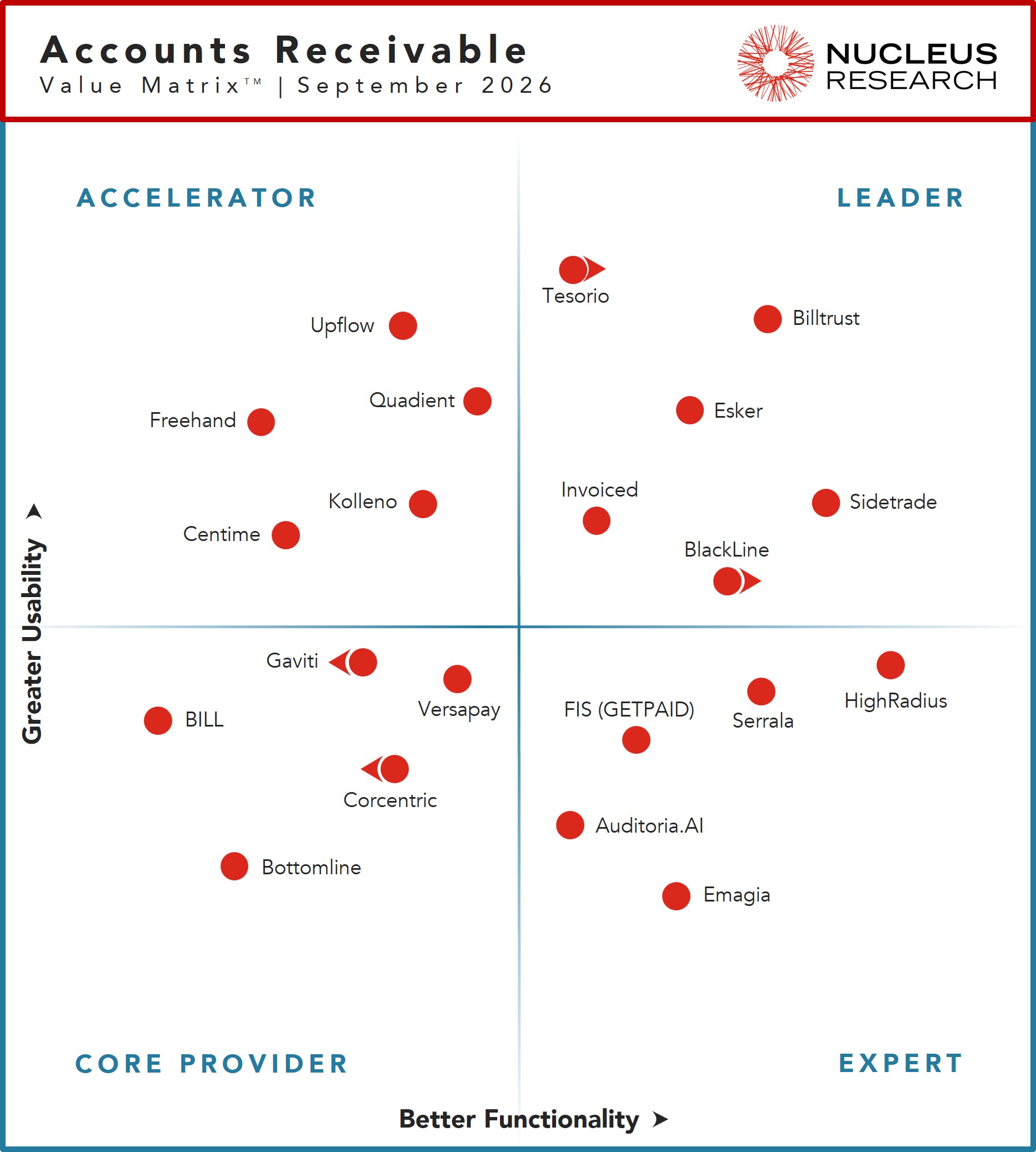
Accounts Receivable Technology Value Matrix 2026
In 2026, the accounts receivable market is defined by a change in who the software must satisfy. Budget authority has shifted from the receivables manager to the controller and the treasurer, and vendors have repositioned to match. Several have assembled branded finance suites that seat receivables next to payables, treasury, and forecasting on shared data. Specialists have taken the opposite bet, that a receivables team is better served by a narrow product it can stand up and run itself, and that argument carried in several of the purchase decisions reviewed for this research. Both strategies are converging on the same unfinished work. Sending and chasing an invoice is largely handled, and the returns from that work are already booked. But reconciling a payment, settling a short pay, and setting a credit limit still consume the function, and those are the tasks that govern how quickly cash clears and how much of the balance sheet is exposed. That is where AI is now aimed. Every vendor evaluated has an agent story, and a small number have production customers, but the more common situation is a licensed capability sitting idle, which puts the start of value at activation rather than at purchase. Buyers should therefore weight cash application accuracy, credit decisioning, and e-invoicing mandate coverage above the lifecycle checklists that every established product satisfies on paper. This year’s Value Matrix separates vendors along that same line, between the depth a receivables team can reach on its own and the depth that only the vendor’s services can unlock.